Friday, March 14, 2014

I received an assignment notice for Nikkei 225 Option

Today I received an assignment notice from my broker that my short option contract on Nikkei 225 (N225) which expired yesterday, 13-Mar-2014.

Was I surprised?  Yes and No.

Yes because N225 is a cash settlement option.  So, I should not be 'assigned' to buy the Nikkei Index component stocks.  After I clarified with the broker, I need not take any action.

No because while N225 close at 14,815.98 on 13-Mar-2014 Japan time, which is about 300+ points above my Strike of 14,500,

N225 Daily as at 13-Mar-2014
N225 Daily


SPX Daily as at 13-Mar-2014
SPX Daily
SPX close 21.86 point down on 13-Mar-2014 US time.  So, N225 should 'crash' more than 300+ points when N225 open for trading on 14-Mar-2014 Japan time.  There is a high chance that it will hit my Strike.

For most Index options, the settlement price is the opening price on the business day following the last trading day.  N225 final settlement price is 14,429.87 (Special Quotations) on 14-Mar-2014.  70.13 points below by Strike of 14,500.  I suffered a loss of JPY 70,130 or USD 689.10 for this contract.

On the expiration day, 13-Mar-2014, I can close this N225 Mar13'14 14500/14250 Put Spread for a profit of JPY 8,600 (~USD 83.94) with a 8 Days on Trade, 11% Return on Margin (ROM).  With the full Iron Condor (including 15750/16000 Call Spread), it will be JPY 36,200 (~USD 353.34), 48% Return on Margin with a 8 Days on Trade.

I didn't.  Because it was the expiration day.  Because delta is only -0.0548.  These are good reasons to stay in the trade.

But not good enough when N225 is just 300+ away from my Short Strike.  A down day for N225 could be easily 300-500 points.

Worst still, when we are talking about a spread of 4 points, JPY 4,200 (~USD 41.27) reward that we are taking the risk.

Mark Wolfinger of "The Rookie's Guide to Options" advice not to risk another day (even on the expiration day) for a penny even when your Strike is quite far away.  You don't know what will happen tomorrow.  Michael Benlifa in his book "Profiting with Iron Condor Options" also advice to take profit when it reach your targeted ROM.

A good lesson learned.  A good experience of being assigned.  A good understanding of it is the next day opening price that matters for Index Options.


Tuesday, March 4, 2014

Trading Options At Expiration

Read the book "Trading Options At Expiration" by Jeff Augen.  In this book,  Jeff discussed the three major forces that happens during Expiration day:

  • Implied Volatility collapse
  • Strike Price pinning effects
  • Rapidly accelerating Time Decay
This is a totally new concept for me as it involves trading option on that single day.  That is a Day Trading options.  I am not ready to day trading options.  Making a note here to revisit at later time.

Monday, February 24, 2014

Two Out of Three

The following are ideas from the book "Profiting with Iron Condor Options", by Michael Benlifa.  I am summarizing the idea and trying to put in into practice in my Trading Plan.  Most of the time you cannot get the perfect trade three out of three considerations below.  You got to choose just two out of three.  Which two?

The three considerations when selling Iron Condors are :
  1. Position : Delta 10s, outside previous highs and lows
  2. Price: Credit of 20% of margin
  3. Time : Expiration is in 4 to 5 weeks
Michael suggest the first two : Position and Price, leaving Time negotiable.


Thursday, February 20, 2014

N225 Index Option Review

After decided not to trade HSI Index Option, I continue to explore another market/product for Option trading, the Nikkei 225.

Option Spec: (http://www.ose.or.jp/e/derivative/225options)

  • Exercise Style : European
  • Contract unit : JPY 1,000 per index point
  • Minimum Spread : 125 point, ie JPY 125,000 (~USD 1221.42)
  • Trading Hours : 9:00-15:15, 16:30-3:00 (Japan Hours)
Cost of Trading
1. Market Data JPY 200.00 (~USD 1.95)
- Osaka Sec Exch JPY 200.00

N225 Market Data cost is ok.  Not too high.  About on par with US Options.  For example, Korea is free, Singapore is SGD 1.00 (~USD0.78) and US Bundle (USD 10.00)  & US Options (USD 1.50) are waived when monthly commission generated reached USD 30.00 & USD 20.00 respectively.

2. Commission
- N225 commission is also not bad.
- 0.18% of option value, min JPY 100 (~USD 0.98) per order
- 0.2% of option value, min KRW 1,000 (~USD 0.93) per order

For a 10% premium collected from Credit Spread,
- N225 commission will take 1% away from the 10% premium received, ie for every $100 premium received, $1 will be deducted for commission.
- K200 commission will only take about 0.76% (depending on contract value) from the premium, ie for every $100 premium received, only about $0.76 is deducted for commission.

3. Margin
- N225 margin is good
- for a N225 Option 125pt Spread (min spread), the Initial & Maintenance margin is about USD 463 & USD 370 respectively
- for a K200 Option 2.5pt Spread (min spread), the Initial & Maintenance margin is about USD 637 & USD 510 respectively

For N225 Option, selling a 125pt Spread to receive say 15 pt (cannot do 12.5 pt. so, 12% premium) is about JPY 15,000 (~USD 146.57), I will need to tied up USD 463/370 initial/maintenance margin.  Return On Margin (ROM) is 31.65%/39.61%.

For K200 Option, selling a 2.5pt Spread to receive say 0.3 pt (adjust to 12% premium as N225) is about KRW 150,000 (~USD 139.90), I will need to tie up USD 637/510 initial/maintenance margin.  Return On Margin (ROM) is 21.96%/27.43%.

4. Option price spread and volume
As with K200, the bid/ask spead is very close, mostly 1-2 ticks wide.  Bid and Ask volume is also good.


Risk/Reward
1. Spread Risk
- min spread is 125 points, which equate to JPY JPY 125,000 (~USD 1221.42) 
- K200 min spead is 2.5 points, which equate to KRW 1,250,000 (~USD 1,165.39)
- this is about the same

2.  Support & Resistance
- as my selection of Strike is primary base on Support & Resistance (that may change), the validity of Support & Resistance is important
- N225 is in general similar to K200, with enough up & down (volatility) but at the same with good support & resistance.


3. Number of Strikes
One problem I have with K200 is the number of Strikes.  It is quite limited.  It is about 26 strike prices(current month) and 18 strike prices (next month).  This make adjustment kind of challenging at times.
N225 does not has this problem.  It has abundant of Strikes to trade.

4. Trading Hours
N225 Trading hours coincide with K200 for T-session (regular trading hours), where the Index is moving.  However, N225 has a T+1 session (non-regular trading hours) that you can continue to trade, even though spread and volume is not as good as T-session. 


Conclusion
N225 Option in many ways are comparable as K200, and better in some areas.  As such, I will be trading N225 in addition to K200.


Karen SuperTrader, February 11, 2014

There is a recent interview with Karen, the SuperTrader on February 11, 2014 on tastytrade.  I cannot find the YouTube version for this recent interview.  You can view the interview at tastytrade.  Need a account to login though.

https://www.tastytrade.com/tt/shows/tasty-extras/episodes/9236

Friday, January 24, 2014

HSI Index Option Review

I want to trade another market/product in addition to K200 Index Option to diversify.  With that, I start to explore Hong Kong Hang Seng Index Option.

Basic Option Spec: (http://www.hkex.com.hk/eng/prod/drprod/hkifo/options.htm)

  • Exercise Style : European
  • HSI Option is HKD 50 per index point
  • Minimum Spread : 200 point, ie HKD 10,000 (~USD  1,288.94)
  • Trading Hours is 9:15m - 12:00noon & 1:00pm - 4.15pm


Cost of Trading
1. Market Data HKD 40.00 HKD (~USD 5.16)
- Hang Seng Indices HKD 15.00
- HKFE Deriv HKD 25.00
- Korean Stk Exch Deriv Free

IB market data is generally cheap.  While USD 5.16 market data per month is not expensive, it is relative more expensive than other exchanges.  For example, Korea is free, Singapore is SGD 1.00 (~USD0.78) and US Bundle (USD 10.00)  & US Options (USD 1.50) are waived when monthly commission generated reached USD 30.00 & USD 20.00 respectively.

2. Commission
- HKD 30.00 (~USD3.86) per contract
- 0.2% of option value, min KRW 1,000 (~USD 0.93) per order

For a 10% premium collected from Credit Spread,
- HSI commission will take 6% away from the 10% premium received, ie for every $100 premium received, $6 will be deducted for commission.
- K200 commission will only take about 0.76% (depending on contract value) from the premium, ie for every $100 premium received, only about $0.76 is deducted for commission.

3. Margin
- for a HSI Option 200pt Spread (min spread), the Initial & Maintenance margin is about USD 1,201 & USD 961 respectively
- for a K200 Option 2.5pt Spread (min spread), the Initial & Maintenance margin is about USD 637 & USD 510 respectively

For HSI Option, selling a 200pt Spread to receive say 20 pt (10% min premium) is about HKD 1,000 (~USD 128.81), I will need to tied up USD 1,201/961 initial/maintenance margin.  Return On Margin (ROM) is 10.72%/13.40%.

For K200 Option, selling a 2.5pt Spread to receive say 0.25 pit (10% min premium) is about KRW 125,000 (~USD 115.75), I will need to tie up USD 637/510 initial/maintenance margin.  Return On Margin (ROM) is 18.17%/22.69%.

4. Option price spread and volume
K200 Option spread is generally about 2 ticks wide.  Selling at midpoint has been generally successful.  The Bid and Ask volume is also good.

However, HSI Option spread is about 4 ticks wide.  Selling at midpoint has been not successful.  The Bid and Ask volume is also comparatively lower.


Risk/Reward
1. Spread Risk
- min spread is 200 points, which equate to HKD 10,000.00 (~USD 1,288.94)
- K200 min spead is 2.5 points, which equate to KRW 1,250,000 (~USD 1,165.39)
- this is about the same

2.  Support & Resistance
- as my selection of Strike is primary base on Support & Resistance, the validity of Support & Resistance is important
- HSI gaps up & down very often.  This make the Support & Resistance not so reliable.  Very unpredictable.  This inherently results in higher risk.
- In addition, the up & down swing could be 300-500, even 700 points in one day!


Conclusion
HSI Option is not easy to trade as there are too many gaps up & down.  And the up & down swing is huge.  This make selection of Strike extremely difficult.  It is thus more risky.  The short strike could be hit easily.  In addition, for the same USD 100 premium received, I will need almost twice the margin as compared to K200.  Not to mentioned, the commission and market data fee is higher.
Therefore, HSI Option is not a suitable market/product for me to trade (at least for now).  I will need to expore some more market/product, such as Japan or Europe Options.

Friday, January 10, 2014

K200 Jan 09 Expiration

These are my trades for K200 09Jan14 contract.

The below chart is K200 Index Daily Chart as at 02-Dec.  Since the K200 was still climbing up with a higher high higher low, my view was still bullish.  However, I was not comfortable with the last swing low at 258.  I wanted a safer Strike lower.  Thus I picked the last resistance at 250.


I sold 5 contracts of K200 Vertical Spread 09Jan14 250.0/247.5 Put, receiving KRW 650,000.00 (before commission)


The below daily chart is as at 17-Dec.  When K200 hit pass the last swing low of 258, I wasn't too sure about my bullish view.  It is showing a lower high lower low now.


I wanted to perform adjustment to my position, however I am not too sure what to adjust.  Should I cut loss now but it still has 8 points before hitting my Short Strike at 250?  Should I roll?  This topic of adjustment is an important knowledge I need to acquire in the near future.  Anyhow, I did something.

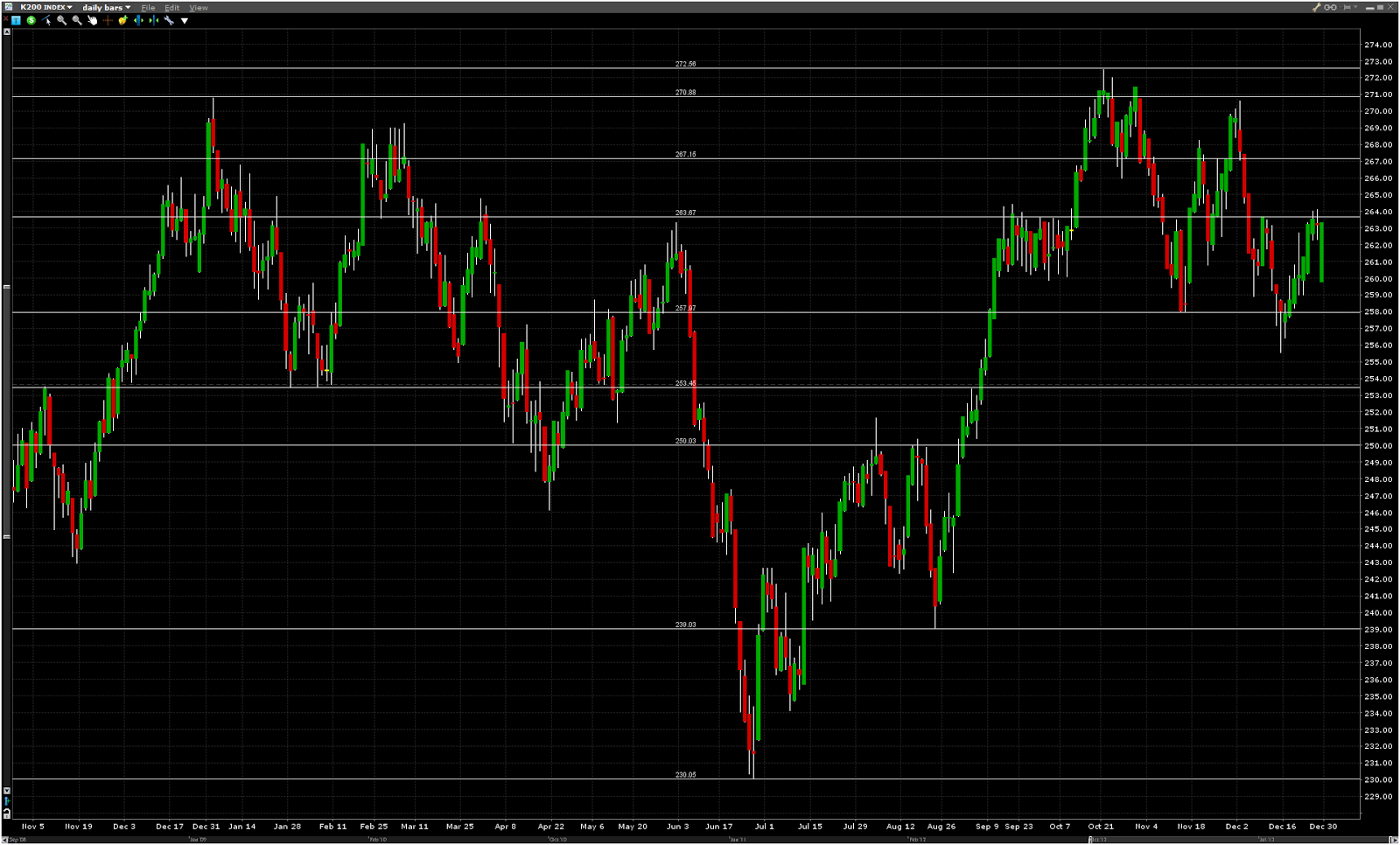
The below Weekly chart is as at 13-Dec.  We can see that K200 is within the trading range of 230-272.50 for the last two years (2012-2013).  There is no Strike price for me to sell 230/227.5 Put Spread.  I decided to sell 272.5/270.0 Call Spread instead.  I wasn't aware that my position became Iron Condor when I sold the Call Spread.  Anyhow, this Iron Condor was in line with my Weekly trading range view.


This is the trade report for 272.5/275.0 Call Spread, which bring in KRW 275,000.00 (before commission).


The below daily chart is as at 27-Dec.  When I saw that K200 failed to break the resistance near 264, I am more convinced with my new bearish view.  I decided to sell another Call Spread.  And I don't think it even can go up beyond the last swing high at 270.


Thus, I took a trade of  Call Spread 270.0/272.5, with a credit of KRW 675,000.00 (before commission).  I wasn't aware that this 2.5pt Call Spread of 270.0/272.5 had combine with the previous 2.5pt Call Spread of 272.5/275.0 into a 5pt Call Spread of 270.0/275.0.  At the same time, it had make a realized profit of KRW 122,850.00 (USD 116.37) after commission.


The below daily chart as at 03-Jan 9.22am confirmed my bearish view.  K200 continued the big drop on 02-Jan and hit pass the last swing low of 255.5.  However, we were just 5 working days (including 03-Jan) away, I didn't think K200 will drop below 250 and 245.  Taking advantage of the high volatility in Put Options, I sold another 5 contracts of 250.0/247.5 Put Spread and 10 contracts of 245.0/242.5 Put Spread.


The additional 5 contracts of 250.0/247.5 Put Spread brought in additional KRW 550,000.00 (before commission) and the 10 contracts of 245.0/242.5 Put Spread brought in KRW 400,000.00 (before commission), totaled KRW 950,000.00 (before commission).


This is at Expiration on 9-Jan.  K200 closed at 253.63.


All contracts expired worthless.  I got to keep the full KRW 2,406,450.00 (USD 2,263.82) premium (after commission/fee) as profit.  With the realized profit, KRW 122,850.00 (USD 116.37), on 30-Dec, that will be KRW 2,529,300.00 (USD 2,380.19) for January.