Showing posts with label Strategies. Show all posts

Wednesday, May 6, 2015

Trading Iron Condor

image: from book cover

"A condor is a big bird with a wingspan that can reach 10 feet.  When it flies, it flaps only occasionally and glides most of the way.  The silent, patient image of this lovely bird floating through time and space will provide a useful metaphor for the trade you will learn.

Like the flapping of its wings, the opening and closing of a condor trade should be done infrequently.  The patient drift through calm air reflects the slow and steady time decay and the low volatility that will lift our profits.  Treat this awesome bird with the respect it deserves and you can ride on its wings."

Profiting with Iron Condor Options, by Michael Hanania Benklifa.


Tuesday, July 29, 2014

K200 Options cannot be defended

K200 close at 268.01 on Tuesday, 29-Jul, up 4.54 points in 2 days.  While I have expected it to move to 267-268 range, I didn't expect it to move so fast.


As at Wenesday, 30-Jul, 12.38pm Korea Time,  it move up another 3.12 points to 271.13.


Refer the Option Chain below:


Say, you have a Bear Call spread of Sep11'14 277.5/280.  Your short 277.5 Call is still about 6 points away but its Delta is 0.3230.  It is a basic rule to defend/adjust your Credit Spread when the Short Strike Delta is above 0.25-0.30.  A normal defending strategy (adjustment) will be roll out or roll up or both.

Firstly, you cannot roll up!  There is no Strikes beyond 280.  You cannot even roll up to 282.5/285 which is the nearest Spread you can roll up.

Secondly, you also cannot roll out!  To roll out, basically you will roll to next month with the same Strikes.  But you cannot roll out to Oct08'14 277.5/280!  There is no price available for 280 Call.  Even if 280 Call price is available, you might not want to just roll out as Oct08'14 277.5 Call is having a Delta 0.3887, higher than Sep11'14.  You won't want to roll out to a higher Delta.

Lastly, typically, we will roll out and up.  But, obviously,  you cannot roll out and up.  There is no Strikes higher than 280 in Oct08'14!

This is a serious limitation in trading K200 Options.  Looks like the only strategy is close the position and cut loss.


Monday, February 24, 2014

Two Out of Three

The following are ideas from the book "Profiting with Iron Condor Options", by Michael Benlifa.  I am summarizing the idea and trying to put in into practice in my Trading Plan.  Most of the time you cannot get the perfect trade three out of three considerations below.  You got to choose just two out of three.  Which two?

The three considerations when selling Iron Condors are :
  1. Position : Delta 10s, outside previous highs and lows
  2. Price: Credit of 20% of margin
  3. Time : Expiration is in 4 to 5 weeks
Michael suggest the first two : Position and Price, leaving Time negotiable.


Monday, October 28, 2013

Vertical Spread

In the Selling Option post, I mentioned Selling Option strategy has limited reward (the premium we received) with unlimited risk.

There is a way to address this unlimited risk by buying another Option with the same expiration and have the same underlying asset.  That is a Vertical Spread.

A Vertical Spread is the simultaneous purchase and sale of options of the same class (calls or puts) and expiration, but with different strike prices.

By selling a Put at a higher price and buying another Put at lower price, it is called Bull Put Spread or Credit Put Spread.  It is called Bull Put Spread strategy because it is a Bullish strategy.  It is called Credit Put Spread because you will receive a positive cash flow or credit by executing this strategy.

Let's use a Example to compare and contrast Naked Put strategy with Bull Put Spread strategy.

ASML has been in a bullish uptrend throughout 2013.  The recent weakness has sent the price retrace to price support at 92.30.  Our Stop Loss is the last swing low support at 87.00


Selling Naked Put
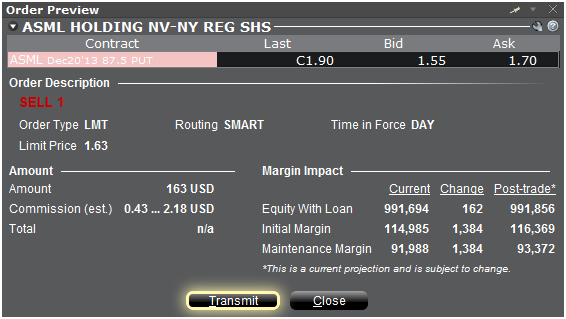
There is no Strike Price at 87.00.  There two nearest are 85.00 and 87.50.  I therefore chose 87.50 Strike price with December Expiration : ASML Dec20'13 87.5 PUT.


I queue for mid point 1.63 (Bid is 1.55; Ask is 1.70).  Didn't get it after 1 hour.  Decided to just buy from Bid (ya, it dropped from 1.55 to 1.50).  So, I received $150 (before commission) in premium.

With the margin of $1,384, the ROM (Return on Margin) is 150/1384 = 10.83% for 63 days.

Maximum loss is unlimited or price drop to 0, ie 87.50 * 1 * 100 - 150 = $8,600.


Vertical Spread : Bull Put Spread / Credit Put Spread

Components : Sell ASML Dec20'13 87.5 PUT
                      Buy ASML Dec20'13 85 PUT

As the premium for the spread is very low, just $24 for 1 contract at mid point $0.48.  I have to increase to 5 contracts to have a comparable size with the Naked Put position.


Same as Nake Put trade, I queued at mid point $0.48 for 1 hour without filled.  Decided to just take bid price 0.35.  Therefore, premium collected is $175 (before commission).


Margin, however, is only $1,250 lower than Naked Put 1 contract margin.  ROM is 175/1250 = 14%.

Maximum loss = (87.5 - 85) *5 * 100 - 175 = 1,075. (difference between strikes minus credit)


Summary:
Vertical Spread address the unlimited risk we have when selling Naked Put.  In addition, it requires less margin and provide a better return on margin.


Sunday, September 29, 2013

Selling Options

In the last two posts, I have discussed about buying options, both call options and put options.  Today, I want to discuss the opposite : Selling Options.

For the Options (Put or Call) buyer, we have limited risk (the premium we paid) with unlimited potential rewards.  For the Options (Put or Call) seller, we have limited reward (the premium we received) with unlimited risk.

It is for this unlimited risk that most traders avoid options selling.

If you avoid options selling, you will miss out the unique features of Options trading.  And, thus, the advantages of using Options in trading.

Unlike other products (Stock, Futures, Forex, etc)  for trading, Options has an unique feature called Time Decay.  All Options lose time value every day.  It loses time value at a faster rate as you get closer to the expiry date.

The other unique feature is Expiration.  Option becomes worthless when it expired, regardless whether it still has any intrinsic value or not.  Say, you bought a Call Options, it has an intrinsic value of $5.00 on the last day of trading.  You forgot to close your position, by selling your Call Options.  The next day, it becomes worthless, even it has an intrinsic value of $5.00.

When we buy Options, time is working against us.  When we sell Options, time is working for us.  It is this unique feature that give seller the advantage and edge in trading options.

When we buy Options, say Call Options, we need not only be right in our direction (price rise in future), we need to be right before expiration.  Not only price need to rise, it need to rise by a sufficient amount to offset the time decay for us to make a profit, before expiration.

For Options seller, say Put Options, we just need to be right that price didn't drop a lot.  We will make a profit 4 out of 5 scenario below:

1. Stay flat (win)
2. Rise a little (win)
3. Rise a lot (win)
4. Drop a little (win)
5. Drop a lot (loss)

Say, we have established a bullish view on Ford Motor (F) stock.  On 20 August, price closed at 16.31 above the support at 16.00.  We believe that the retracement has stopped.  Price should went back up to test the last swing high at 17.67.  However, if our bullish view is wrong, we are prepared to stop loss at the next support at 15.18.


Thus, we sold 10 contracts of F Oct19'13 15 Put @0.30.  We received $300 (excluding commission) for the premium.

From 20 August to 19 October, F stock price can stay flat, rise a little, rise a lot or drop a little (above the Strike Price of 15.00), we will get to keep the full $300 (excluding commission).

Price close at 17.05 on 27 September.  Let's review it again in mid October or when it expired.

Similarly, for selling Call Options, we will make profit 4 out of the 5 scenario below:
1. Stay flat (win)
2. Rise a little (win)
3. Rise a lot (loss)
4. Drop a little (win)
5. Drop a lot (win)

It is this unique advantage and edge as a seller that got me interested in Options Trading, on top of my Futures and Forex trading.  Options selling is effectively an 80% (4 out of 5) winning system.

Tuesday, September 24, 2013

Buying Put Options

The next simple strategy we shall consider is : Buying Put Options.  Similar to Buying Call Options, it is simple because we can relate it to Shorting Stocks or Futures or Forex.  It is also attractive to beginners because maximum profit potential is unlimited while maximum loss potential is limited to premium paid.

Even though Buying Put Options is similar to Shorting Stocks or Futures or Forex when you have a bearish view on the Stocks or Futures or Forex, there is a one very big difference.  For Stocks or Futures or Forex, you are Shorting, means you are Selling.  For Put Options, you are actually Buying.

So, when you have established a bearish view on XYZ stock.  You will Short/Sell the XYZ stock.  If you use Put Options, you will instead Long/Buy the Put Options.

Call Options give the Buyer the right to Buy the underlying Stock at Strike Price.
Put Options give the Buyer the right to Sell the underlying Stock at Strike Price.

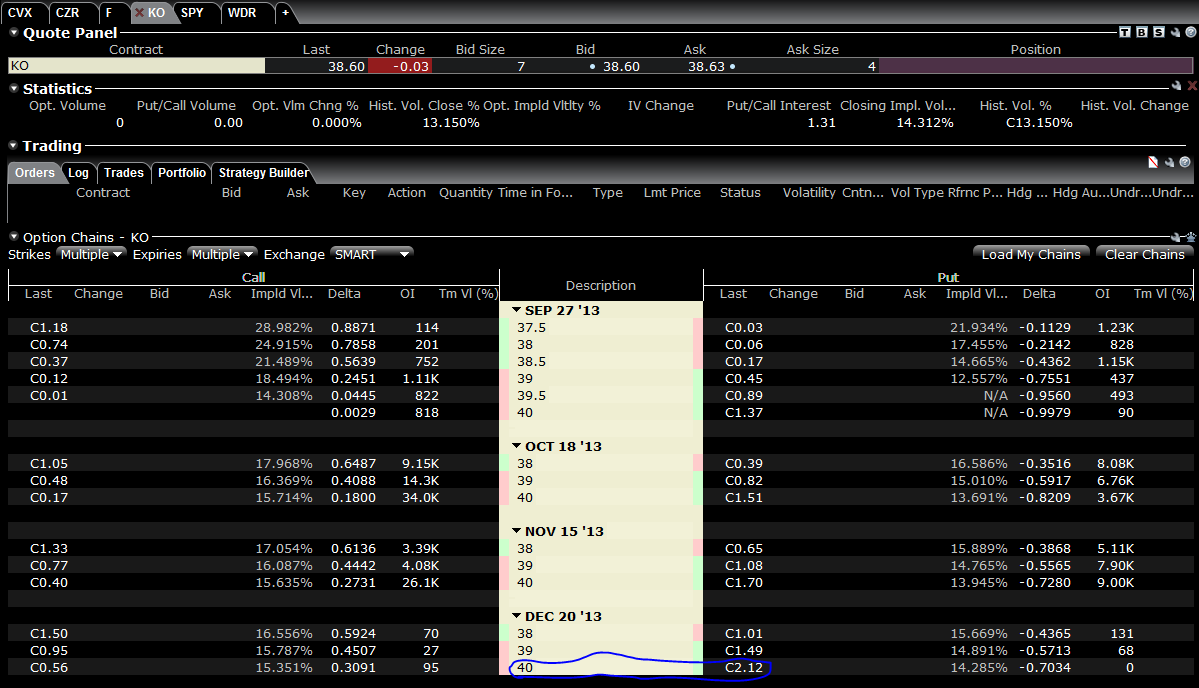
Let me use an example to illustrate.  KO is trading at 38.63 after it failed to break the resistance at 39.60.  And it fell below the downtrend line.  We are bearish on KO.  We can Short/Sell KO at current price 38.63 with a stop above the resistance line 39.60, say at 40.00.


To implement that in KO Put Options, I will use the same guideline established in Buying Call Options (see the post here):
1. Underlying Stock : KO
2. Expiration : at least 2 months
3. Strike Price : ITM and Stop Loss price
4. Call or Put : Put
5. Price :

So, I will buy KO Dec20'13 40 Put @ 2.12 (yesterday close).   Using Options Calculator, the theoretical Options price is about 1.94 when KO is at 38.63 and about 1.13 when KO is at 40.  The potential lost is about $81 (1.94-1.13 * 100).  The theoretical price is different from (lower than) the actual market price.  I hope the difference is about the same.


Thursday, September 19, 2013

Buying Call Options

We shall continue with the simplest strategy : Buying Call Options.  This is the simplest strategy because it is very similar to Buying Stocks or Futures or Forex.  It is easy to follow.  It is also attractive to most beginners because maximum profit potential is unlimited while maximum loss potential is limited to premium paid.

After we have established a Stop Loss method, the next question is : What is the Entry?  For Options, it is more of What Options to buy.

Say we have established a bullish view on XYZ stock.  We want to buy XYZ Options.  They are many Options available for XYZ stock.  Which one to buy?  There are 5 pieces of information you need before you can buy:
1. Underlying Stock : assume we have already decided on a bullish stock XYZ
2. Expiration Month/Dates
3. Strike Price
4. Call or Put : it will be Call since we are using Buying Call Options strategy
5. Price :


Expiration : at least 2 months
Time is a critical factor in Buying Call Options strategy.  Every day that we hold an Option, the time value of our Option will decrease.  And it will decrease at an increasing rate as we approach the expiry date.

So, we should not be buying Call Options that is expiring in near term, say in the current month.  Not only there is very little time for the price of the underlying Stock to increase for our bullish strategy to work out, the time value is going to decrease at an increasing rate as we approach the expiry date.

We are playing against time.  The price of the underlying stock needs to increase by a sufficient amount before the expiry date for us to make a profit.

Therefore, for a start, I am only going to buy Call Options that have at least 2 months till expiration.


Strike Price : In The Money (ITM) and Stop Loss price
When the Strike Price is higher than the Stock Price, our Call Options is Out of The Money (OTM).  The premium we pay for the Call Options are all Time Value.  If the Stock Price didn't increase above the Strike Price at the expiry, the Call Options time value will become zero.  The Call Options will expire worthless.  We will loss all the premium.  The Stock Price need to increase sufficiently above the Strike Price to firstly offset the premium we paid for the Option.  And need to increase even further to make profit.

When the Strike Price is the same as the Stock Price, our Call Option is At The Money (ATM).  Similarly, the premium we pay for the Call Options are all Time Value.  It will be almost the same as OTM.

Therefore, I will only buy Call Options that is In The Money (ITM) which the Strike Price is lower than the Stock Price.  In fact, I will choose the Strike Price to be the Stop Loss price where the trade is no longer valid.

In conclusion, I will only buy Call Options that will expire at least 2 months away and it is ITM with Strike Price same/close to my Stop Loss price.